



It does not receive public funding
Editor in chief:
CLARA MOSCHINI
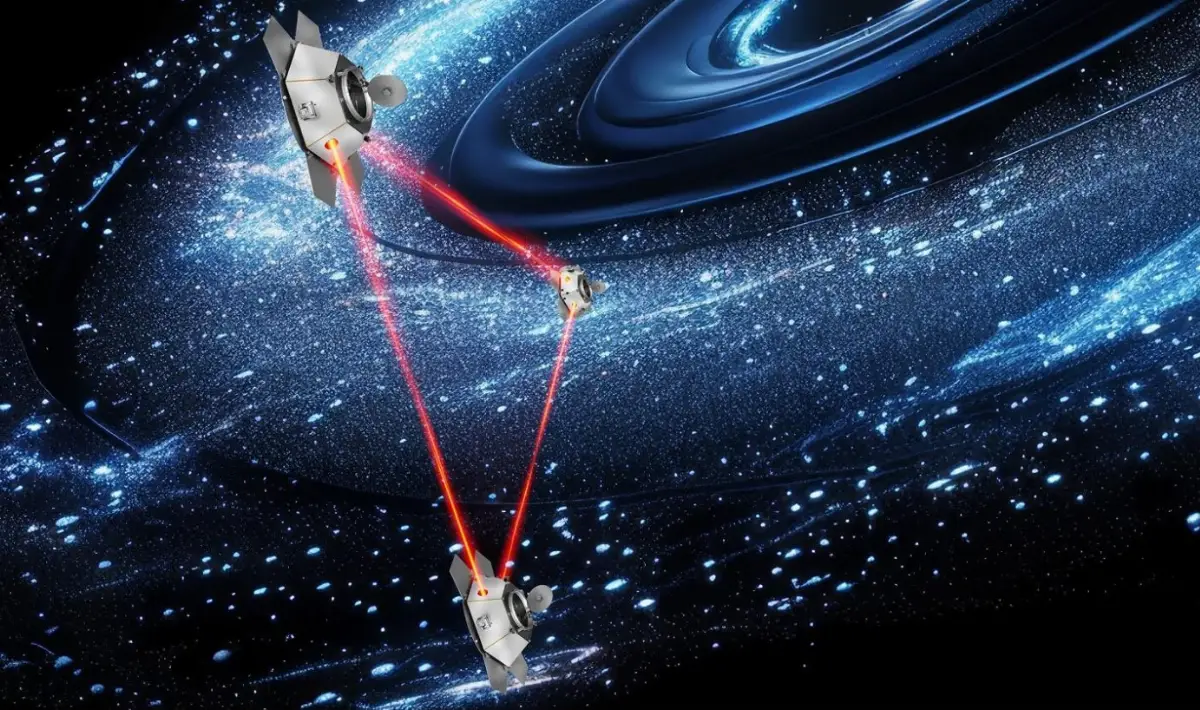
Thales Alenia Space (TAS), the joint-venture between Thales (67%) and Leonardo (33%), has signed a € 16.5 m contract with prime contractor OHB System AG to provide the Propulsion Subsystem for European Space Agency's LISA- mission.
LISA (Laser Interferometer Space Antenna) will be the first space-based observatory dedicated to studying gravitational waves.
In the UK,TAS will be responsible for the design, manufacture, system assembly, integration, testing of the Propulsion Subsystem for LISA. This Phase B2 contract will be followed by Phase C and D, with a total contract value of € 89.5 m. LISA: a future constellation of three satellites spaced 2.5 million kilometers apart.
LISA will detect gravitational waves, ripples in space-time predicted by Einstein’s general theory of relativity generated by massive accelerating objects, with a sensitivity and in a frequency range that cannot be measured from the ground.
This groundbreaking mission will enable scientists to study gravitational waves generated by many different types of events, from interacting compact stars to merging supermassive black holes at the cores of galaxies, and to expand our cosmic horizon back to the epochs preceding the formation of stars and galaxies.
The spacecraft must be meticulously designed to ensure that no forces, apart from the geometry of spacetime itself, influence the movement of the masses, so that they are in near-perfect free-fall along the measurement directions.
The mission will feature a three-satellite constellation positioned in a triangular formation, spaced 2.5 million kilometers apart, trailing or preceding Earth in its orbit around the Sun. Each satellite will carry two reference masses, and laser beams will be transmitted between the satellites to measure displacements between these masses with a precision smaller than the diameter of an atom. The three satellites are scheduled to launch in 2035 aboard an Ariane 6 rocket.
Thales Alenia Space will provide prime contractor OHB System AG with several mission-critical elements, including the spacecraft avionics and control software, the telecommunication system, and the drag-free and attitude control system (DFACS). This is a core component of the LISA mission. It will perform the “constellation acquisition” operation, consisting in establishing and maintaining the laser links between the satellites, and will compensate the non-gravitational forces on the spacecraft, such as solar radiation pressure, so that the test masses follow a purely geodesic motion along the satellite-to-satellite direction. TAS is also responsible for ensuring the exceptional electromagnetic, radiation, and selfgravity operational environment for the payload, essential to mission performance, for which TAS is also managing the budgets.
Leonardo is also contributing with its technologies to the mission with some key equipment, such as the micro propulsion assemblies, a highly precise system of thrusters used to control the satellite’s attitude with extreme accuracy.
Thales Alenia Space in Turin, Italy, as member of the LISA Core Team makes use of the experience and design solutions inherited from the five-year study phase led by TAS as the prime contractor. Its facility, in Gorgonzola (Milan), Italy, will develop the On Board Computer and the Mass Memory in the same integrated unit. TAS in Switzerland is involved in developing part of the instrument's electronics and of the Constellation Acquisition System for LISA. Other company sites will also have the opportunity to contribute to the LISA mission, supplying spacecraft subsystems or equipment.
The spacecraft builds on the legacy of LISA Pathfinder, which successfully demonstrated the ability to maintain test masses in free-fall with an extraordinary level of precision. The same precision propulsion system, which has also been utilized on ESA’s Gaia and Euclid missions, will ensure that each spacecraft keeps the laser interferometer beams pointed at the remote spacecraft 2.5 million kilometers away with the utmost accuracy.