



It does not receive public funding
Editor in chief:
CLARA MOSCHINI
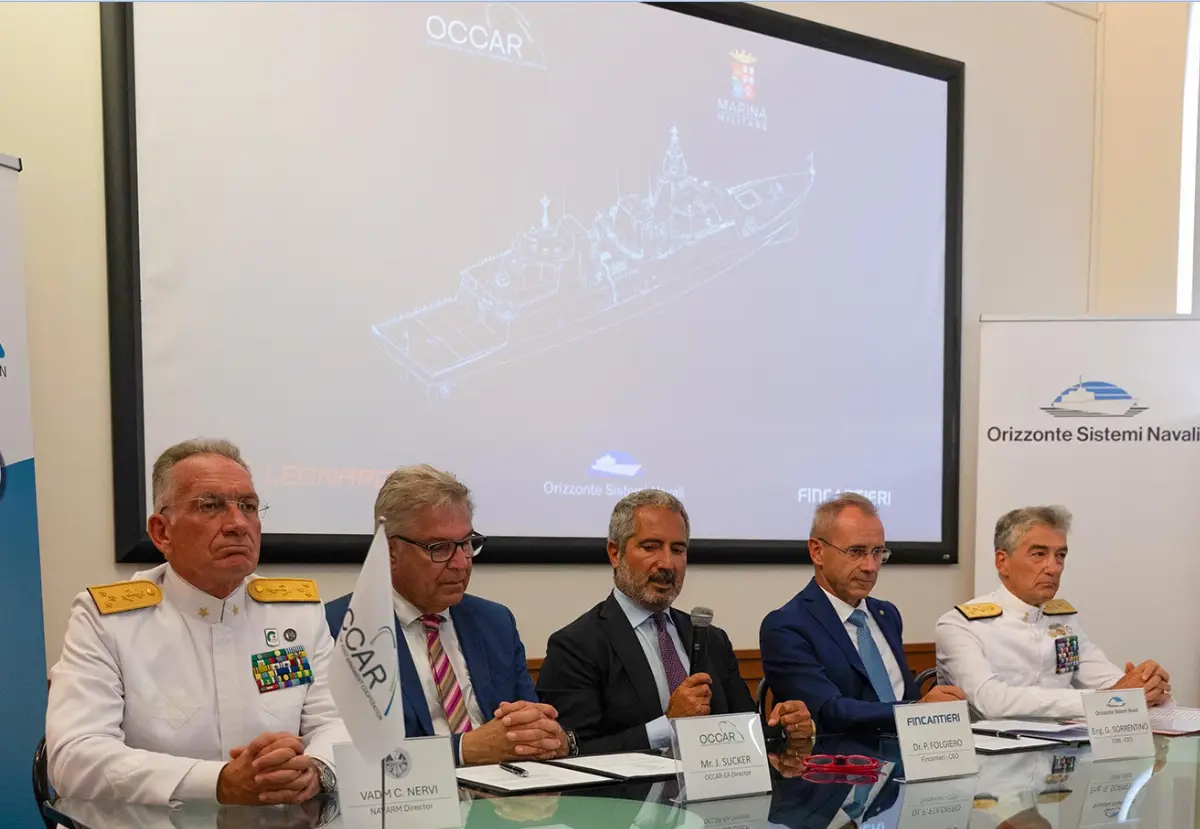
Delivery of the first and second units is scheduled for 2033 and 2035, respectively
Orizzonte Sistemi Navali (OSN), a joint-venture between Fincantieri (51%) and Leonardo (49%), has signed a contract with OCCAR (Organisation Conjointe de Coopération en matière d’Armement) with a total value of approximately €3.7 billion, of which approximately €1.3 billion is in options, for the development, production, logistic studies and Initial In Service Support (ISS) of two new generation DDX destroyers for the Italian Navy.
As part of the programme, in the coming weeks OSN will enter into sub-supply contracts with Fincantieri and Leonardo, respectively worth approximately €1.8 billion (of which approximately €800 million in options) and approximately €1.7 billion (of which approximately €480 million in options).
The signing marks the official launch of one of the most significant programmes for the future of Italy’s naval defence capabilities and introduces a new generation of units designed to operate in maritime scenarios characterised by increasing complexity, rapid technological evolution and ever-greater integration across the different operational domains.
The DDX programme is set to redefine the Italian Navy’s capability profile in the field of air and missile defence through a significant generational leap involving both the naval platform –designed and developed by Fincantieri as system integrator, together with its increasingly advanced digitalisation– and the combat system, designed and developed by Leonardo.
The new ships will be designed to operate within highly interconnected multinational forces and will feature high levels of digitalisation, automation and integration among sensors, weapon systems, multi-domain command and control systems, and platform management systems. The combat system architecture will also be developed to ensure high levels of interoperability and information sharing and management.
Key innovations envisaged for the platform include a DC power sub-network with its associated energy storage system, an innovative stabilisation system integrated with the steering system, new algorithms and methodologies for calculating thermal and electrical balances, and further digital developments of the Ship Management System.
On the combat system side, thanks to the new-generation SADOC 5 C5I, a high-power, fully digital S-band AESA radar and MBDA’s weapon system, the DDX unit will feature an unprecedented IAMD (Integrated Air & Missile Defence) capability against missile, ballistic and hypersonic threats, ensuring the full multi-domain interoperability that lies at the core of the technology underpinning Leonardo’s Michelangelo project.
The two units will be built by Fincantieri and Leonardo, through OSN, leveraging design, engineering and production expertise developed over decades of leadership in the design and construction of technologically advanced naval vessels. Delivery of the first and second units is scheduled for 2033 and 2035, respectively.
Lorenzo Mariani, Chief Executive Officer and General Manager of Leonardo, said: “Taking part in this programme – which is set to establish new standards in naval defence capabilities – confirms the Italian Navy’s confidence in Leonardo’s technologies, which are capable of meeting the need to operate in an integrated manner across different domains and in complex scenarios. Today more than ever, it is essential to rely on multi-domain systems. Leonardo’s continuous investments in this direction have enabled the development of digital and system architectures that integrate capabilities designed to ensure effective assessment of scenarios and speed in decision-making processes throughout the entire chain of command. With these two new-generation units, the Armed Force will be able to rely on naval platforms offering advanced operational performance and capable of addressing a broad spectrum of threats. The important result achieved with the signing of this contract is also further evidence of how Italy’s national defence industry, represented in this case by Leonardo and Fincantieri, can, by working in synergy, deliver innovative and strategic expertise, helping us move towards greater technological autonomy and contributing to the growth of Italy and Europe".
The two ships to be built by Fincantieri represent the evolution and replacement of the Horizonclass destroyers. The 180-metre-long DDX platform, with a displacement of 13,500 tonnes, a range of 4,000 nautical miles and a crew of 251, combines innovation in naval engineering, digital technologies and electronics. A true system of systems, it is capable of delivering largescale defence and deterrence capabilities, while enabling the surface domain to converge with the underwater domain.
Equipped with an electronic brain that makes the ship “thinking”, the DDX embodies the Navis Sapiens concept developed by Fincantieri: a digital ship capable of intelligently collecting, correlating and leveraging data generated by all onboard systems, transforming it into information useful for operational decision-making, technical management and support throughout the entire lifecycle. With an open and scalable design, the platform can integrate new functionalities and emerging technologies, overcoming the obsolescence issues affecting technologies in the naval market. Navis Sapiens’ connectivity with shore enables the creation of a Digital Ecosystem (Fincantieri Digital Ecosystem) for the Italian Navy, interconnecting the Digital Ship with the Digital Naval Base and bringing together distributed data and capabilities, data sharing for predictive maintenance and digital logistic support, as well as mission information made immediately available onboard in secure conditions. All of this delivers significant benefits in terms of improved mission readiness, increased operational availability, supply chain responsiveness, accelerated crew rotation, more efficient resolution of issues, and interoperability across different domains.
At a speed of 15 knots, thanks to an innovative digital backbone developed by Fincantieri, each ship will be capable of managing unmanned assets such as underwater and surface drones in an integrated manner, strengthening capabilities for detection, discovery and protection against aerial threats, including ballistic threats, as well as surface and underwater threats. At the same time, it will optimise consumption across both the ship’s propulsion and electrical systems and deliver unprecedented advanced connectivity.
With the DDX programme, Italy’s naval and defence industry is preparing to introduce a technologically advanced platform designed to ensure that the Italian Navy has the operational capabilities required for future scenarios and plays a leading role in national and multinational naval operations. The programme will also contribute to strengthening the pool of expertise, technologies and strategic industrial capabilities developed across the national supply chain.