



It does not receive public funding
Editor in chief:
CLARA MOSCHINI
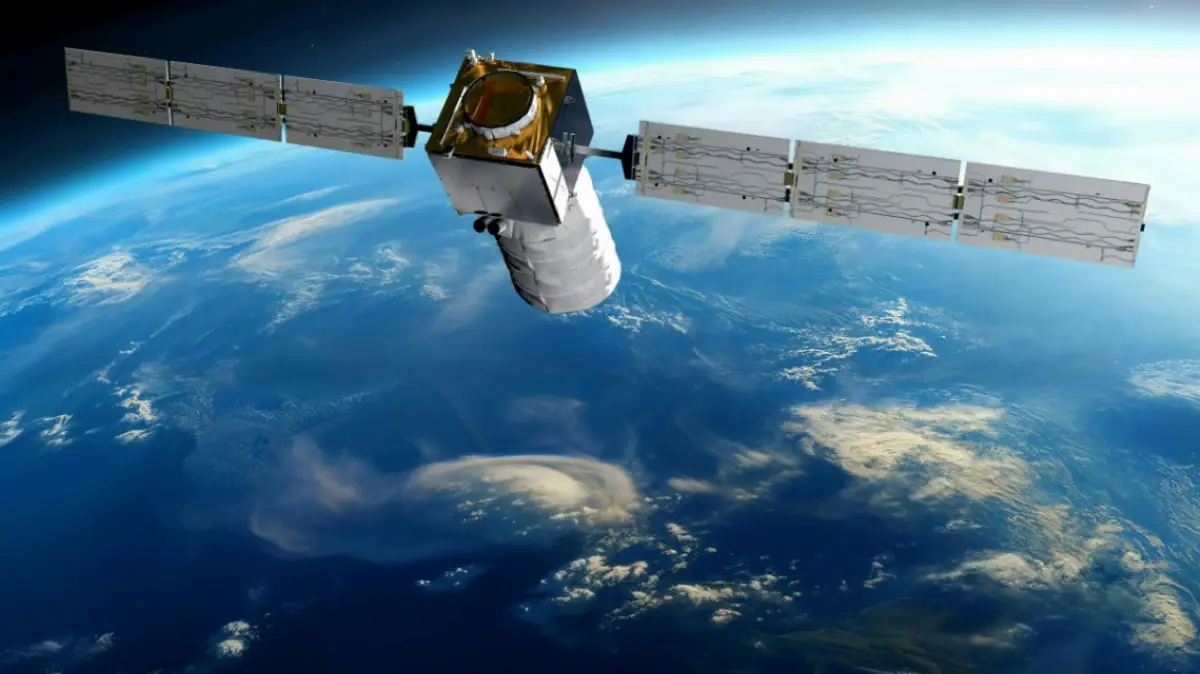
Airbus Defence and Space has signed the initial contract for the design and build of the Aeolus-2 wind sensing satellite from the European Space Agency (ESA) at a ceremony at ESA’s UK headquarters ECSAT at Harwell.
Aeolus-2 will follow the first Aeolus wind sensing satellite built by Airbus and launched in 2018. The satellite provided the first-ever high-resolution vertical wind profiles from space, enabling a 4% improvement of numerical weather forecasting, and significantly enhanced the accuracy of global weather prediction models benefiting European stakeholders and society.
Data from Aeolus, which flew in orbit until 2023, significantly enhanced the accuracy of global weather prediction models and provided critical data for understanding atmospheric circulation and long-term climate change. Aeolus-2 will also be equipped with another pioneering Doppler wind lidar with ultraviolet lasers which will scan from the ground up to 30km taking measurements every 0.01 seconds, covering all of the globe every seven days. Aeolus-2 will have an additional detector to measure aerosols in the atmosphere.
The first Aeolus satellite helped improve knowledge of hurricanes, and of how volcanic ash travels in the high atmosphere. It also improved data availability at the poles and the equator, reducing the mean error between predictions and observations by more than 4%.
Light from the lasers on Aeolus bounce off small particles such as dust, ice and water droplets, and the light scattered back collected by the telescope shows the speed and wind direction based on the Doppler shift of the particles.
Aeolus-2 is being developed by the European Space Agency (ESA) in partnership with EUMETSAT (European Organisation for the Exploitation of Meteorological Satellites) and will benefit major weather centres, including the UK’s Met Office and European Centre for Medium-Range Weather Forecasts (ECMWF).
It will orbit the Earth 15 times a day and deliver data to users within 120 minutes of the oldest measurement in each orbit. The satellite will be in a 450 km orbit and a lifetime of 5.5 years.