



It does not receive public funding
Editor in chief:
CLARA MOSCHINI
The serious Thessaloniki incident has reopened technical questions surrounding the Boeing 737 NG. Meanwhile, hundreds of pilots are challenging the contractor model before a London court. Two separate stories, but both highly uncomfortable for Europe’s largest low-cost carrier.
For Ryanair, the summer of 2026 is unfolding on two very different fronts: flight safety and employment practices.
The NTSB preliminary report into the July 10 incident states that a Malta Air Boeing 737-800 operating as Ryanair flight 1879 from Thessaloniki to Memmingen suffered a fan-blade separation in its right-hand engine while climbing through approximately 16,000 feet. Engine fragments penetrated the pressurised fuselage and destroyed the cabin window at row 11.
The passenger sitting beside the opening was partially sucked towards the outside of the aircraft before being pulled back into the cabin by fellow passengers. He sustained injuries classified as serious. The crew initiated an emergency descent and returned safely to Thessaloniki.
The investigation has not yet established the probable cause. Bird remains were found inside the engine, which had also been involved in four suspected bird strikes during the previous 12 months. However, investigators also identified features on the fractured fan blade consistent with high-amplitude fatigue. Ultrasonic inspections carried out in November 2025 and May 2026 had revealed no anomalies.
Three FAA-mandated modifications designed to strengthen components of the engine nacelle had not yet been incorporated on the aircraft. The operator was nevertheless still within the regulatory compliance period, as the deadline is July 2028. In light of the incident, however, it is reasonable to ask whether that deadline should now be brought forward.
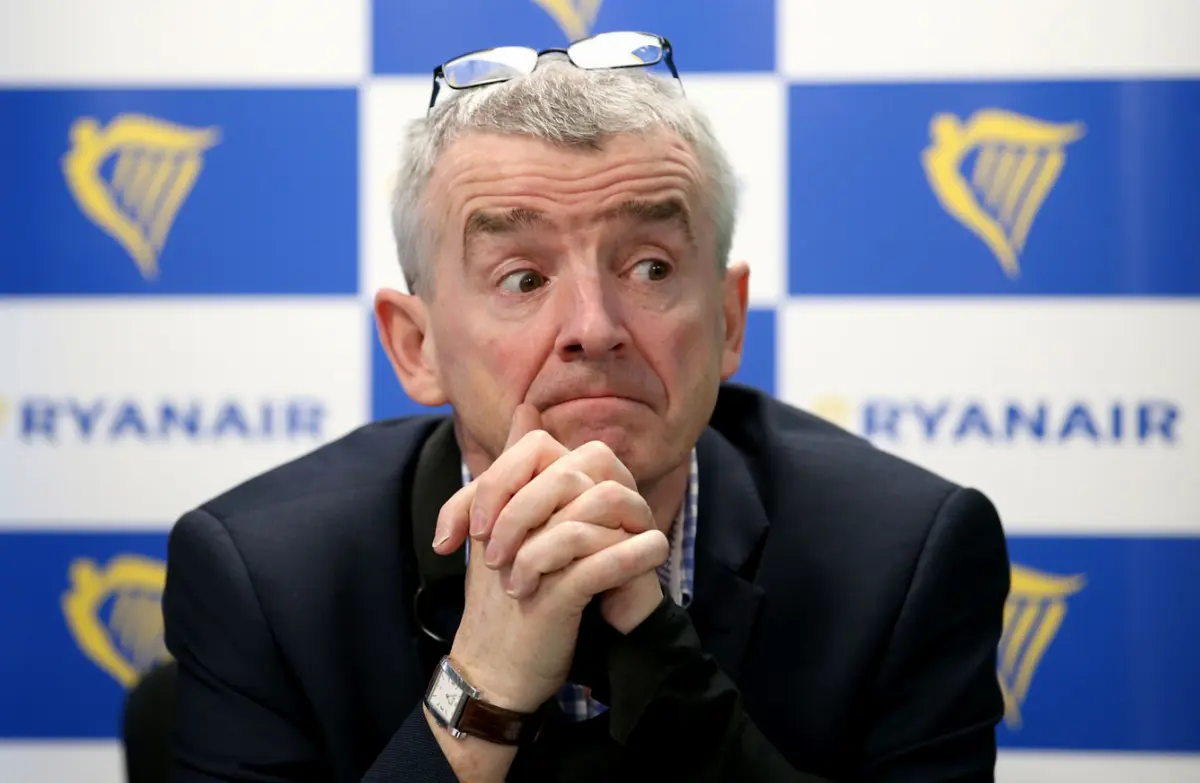
Michael O’Leary had initially identified foreign object damage as the most likely explanation, suggesting that neither the aircraft’s age nor its maintenance history was involved. The NTSB subsequently formally admonished him, stressing that no possible contributing factor had yet been ruled out and reminding parties to the investigation of their confidentiality obligations.
On the employment front, 262 former pilots, led by Captain Richard Phillips, filed a group claim on July 30 in London’s Commercial Court against Ryanair, Storm Global, Brookfield Aviation International and Scanlon Associates.
The claimants argue that they were classified as self-employed contractors despite effectively working as personnel fully integrated into the airline’s organisation. They are seeking backdated holiday pay, pension contributions and other statutory protections. The proceedings remain at an early stage and no liability has yet been established.
There is, however, a significant precedent. In the Jason Lutz case, the UK Court of Appeal found that the pilot was a worker of Storm Global and an “agency worker” supplied to Ryanair, rather than a genuinely self-employed contractor. The Supreme Court subsequently refused permission for a further appeal.
A German social court has also recently considered pilots who were formally self-employed to be workers fully integrated into Ryanair’s organisation, although the judgment is not yet final.
The issue is not new in Italy. In 2013, the Italian Revenue Agency served pilots and cabin crew based at Bergamo Orio al Serio with tax assessments ranging from €8,000 to €40,000 — with pilots facing demands of up to €40,000 — as a result of the controversial tax arrangements applied in previous years. At the time, the CGIL union argued that the cost of contractual and fiscal uncertainty was being transferred directly to the workers.
In 2022, the reasons behind industrial action by Italian crews even included the failure to provide drinking water and meals on board, which crew members reportedly had to purchase at their own expense.
There is currently no evidence connecting Ryanair’s employment model with the Thessaloniki incident. Nevertheless, the juxtaposition remains uncomfortable: while safety investigators warn against drawing premature conclusions, courts are reminding the industry that contractual labels cannot automatically turn a de facto employee into an entrepreneur.
In aviation, even transparency cannot be low-cost.