



It does not receive public funding
Editor in chief:
CLARA MOSCHINI
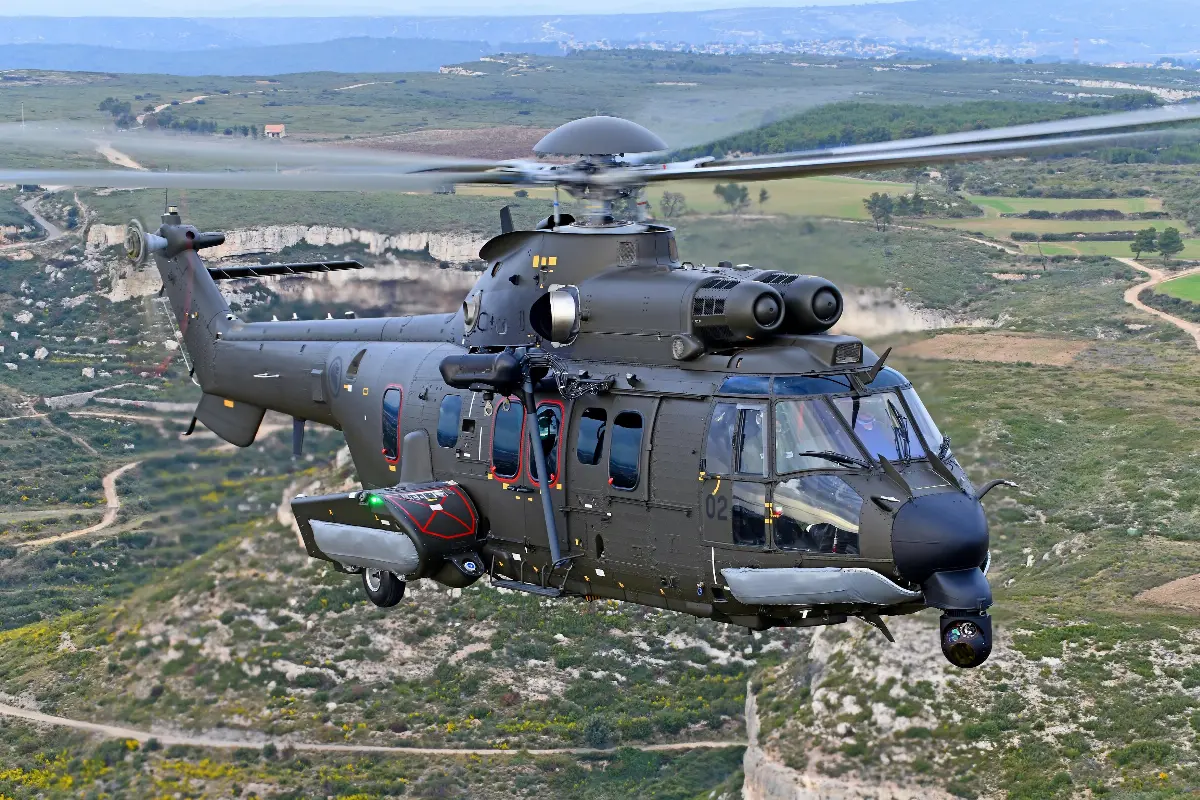
Airbus and Singapore’s Defence Science and Technology Agency (DSTA) have successfully concluded a pioneering HTeaming flight campaign at a Singapore airbase. This flight demonstration marks the very first time HTeaming has involved an Flexrotor Uncrewed Aerial System (UAS) and the Republic of Singapore Air Force’s (RSAF) H-225M helicopter.
This followed an agreement signed in June last year, with the two partners exploring how crewed-uncrewed teaming could enhance situational awareness and improve mission outcomes through a flight demonstration campaign.
The trials conducted in January using simulated scenarios, proved that a crewed helicopter can successfully and securely access real-time data from a UAS, significantly extending the aircraft’s visual range and overall mission safety. To demonstrate this capability, the H-225M and Flexrotor teamed up in a search and rescue mission, delivering enhanced situational awareness.
As part of the collaboration, Airbus managed the design of the HTeaming system and its integration into the H-225M, including specialised data-link architectures. This integration enabled the helicopter crew to receive and process real-time data from the Flexrotor while maintaining direct command and control of the UAS. This synergy facilitated rapid decision-making and mission execution while minimising the crew’s exposure to high-risk environments.
Airbus HTeaming is a brand new modular crewed-uncrewed teaming solution designed to be compatible across the entire Airbus helicopter range. As a UAS-agnostic system, it integrates a variety of uncrewed platforms, allowing helicopter crews to take full control of different UAS in flight to meet specific mission requirements.
The Flexrotor is a modern Vertical Takeoff and Landing (VTOL) uncrewed aircraft with a launch weight of 25 kg (55 lbs), it has been designed for ISTAR missions for more than 12-14 hours in a typical operational configuration, and 10 hours in EMSA configuration. It can integrate different types of payloads including an electro-optical system and advanced sensors to suit customers’ unique mission needs. With the ability to autonomously launch and recover from either land or sea requiring only a 3.7 by 3.7 m (12 by 12 ft.) area, the Flexrotor is ideal for expeditionary missions requiring minimal footprint.
As the latest addition to the Super Puma family, the H-225 is recognised for its high performance in challenging conditions as well as its outstanding range and payload capacity. The aircraft’s state-of-the-art avionics and autopilot systems provide increased safety while reducing pilot workload. There are more than 360 H-225s and H-225Ms in service around the world, totalling one million flight hours. Military customers include Brazil, France, Hungary, Indonesia, Iraq, Kuwait, Malaysia, Mexico, the Netherlands, Singapore, Thailand, and Morocco.